
What type of trader or investor are you?
Reading time: 10 minutes
Many beginners enter the financial markets with a single, straightforward objective: to make money. However, if you don’t have a clear understanding of your own financial identity, you might find yourself becoming frustrated. Trying to execute a strategy that conflicts with your personality, lifestyle, or financial situation is one of the most common reasons new market participants might fail.
Research shows that individual differences account for over 70% of systematic variation in risk tolerance. Most experienced market participants understand this and use it to determine their portfolio allocation. In addition, many industry rules of thumb have evolved to account for individual differences among investors, like the ‘100 minus your age’ rule, where 30-year-olds tend to allocate about 70% of their capital to riskier stocks, whereas older investors rely more on fixed-income securities.
One of the first steps in your trading or investing journey is to understand whether your traits are those of a short-term speculator who thrives on fast-paced price action, or a long-term planner who prefers long-term capital growth. Here’s a look at what to consider while determining the type of investor or trader you are.
Determinants of types of investors/traders
Before exploring specific market personas, you need to evaluate three fundamental pillars. These personal characteristics play an important role in dictating the trading strategy that best suits you.
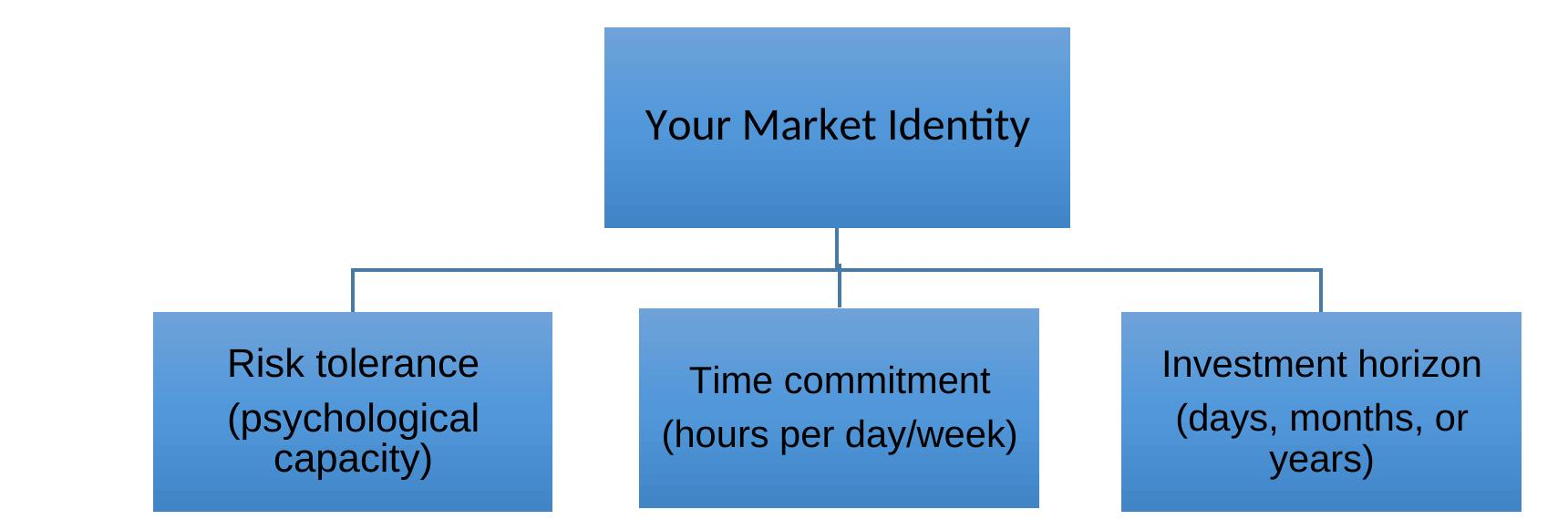
Understanding your realistic risk tolerance
Your emotional response to financial loss is one of the strongest indicators of your true risk profile. It is easy to believe you have a high risk appetite when the markets are moving steadily upward. The true test occurs when your positions move into a drawdown. If seeing a position lose 2% of its value causes you to panic, make impulsive decisions, or lose sleep, you are likely to have a more conservative risk profile. Traders with this profile may prefer less volatile assets.
Conversely, if you can systematically accept short-term losses as a standard part of investing, you may be more comfortable with active, short-term trading styles.
A basic rule of risk management, followed by many experienced traders, is to calculate your maximum risk per trade using this formula:
Risk per trade = Account equity x Risk percentage
For example, if your account balance is US$5,000 and you cap your risk percentage at a conservative 1%, you would not risk more than US$50 on any single position.
Time commitment
Be completely honest about the amount of time you can realistically dedicate to the markets. Active short-term trading tends to be a demanding, high-focus activity. It requires you to monitor the markets, scan order flows and react quickly to breaking macroeconomic news.
If you work a demanding 9-to-5 corporate job, trying to manage fast-paced short-term trades during your lunch break could increase the likelihood of mistakes. If your time is limited, consider a trading style that requires less frequent monitoring, such as swing trading or long-term investing (both are discussed below).
Investment horizon
This is the total length of time you expect to hold a specific position before closing it to realise gains or losses.
- Short-term horizon: Positions are usually opened and closed within seconds, minutes, or hours.
- Medium-term horizon: Positions are typically held for days or weeks to capture broad swings in price momentum.
- Long-term horizon: Positions are generally held for months, years, or even decades to capture structural macroeconomic growth and compounding returns.
Decoding types of traders based on trading style
There are four basic types of traders, based on the time they have available to spend on the markets.
Scalpers
Scalping is a trading style in which positions are held for the shortest timeframes. Scalpers look to profit from small intraday price fluctuations, often holding trades for mere seconds or minutes, using 1-minute or tick charts to catch quick price movements. This highly active trading style needs a strong focus on the charts during active market hours. It is more suited to fast-paced, quick decision-makers who can accept frequent small losses without losing composure.
Because you might execute dozens of trades per day in scalping, transaction costs like commissions and bid-ask spreads need to be considered because they can impact your profits. Also, if you choose this style, you need a broker that offers low-latency execution and tight spreads.
Day traders
Day trading is a style in which you open and close all positions within a single trading session. No positions are held overnight. This avoids overnight fees and the risk of waking up to a significant morning price gap caused by unexpected global events. Day traders follow a medium-short timeframe, typically using 5-minute, 15-minute and 1-hour charts. Day traders actively monitor the market during the opening and closing hours of the major global exchanges. This style is usually best suited for disciplined, highly systematic individuals who can shut down their workstation at the end of the day regardless of whether they booked a profit or a loss.
Swing traders
Swing trading is one of the most popular trading styles among beginners, especially those who can balance market participation with a regular career. Swing traders look to capture price moves that develop over several days or weeks. This is a slow-to-moderate-paced trading strategy in which 4-hour, daily and weekly charts are commonly used. The time commitment is also low to moderate. You might only need to analyse charts for 30 to 60 minutes per day, typically before or after market sessions. This style is suited to patient individuals who are comfortable letting a trade run through normal intraday volatility in the path to reaching a larger profit target.
Position traders
Position trading is a strategy that attempts to capture macroeconomic trends using long-term technical analysis. Position traders hold positions for months or even years, ignoring short-term market noise. This long-term trading style usually focuses on weekly and monthly trend structures. It requires low time commitment, with traders generally reviewing their positions on a weekly or monthly basis.
Decoding types of investors based on financial goals
If active trading feels time-consuming, a long-term investing approach may be better suited to your goals..Here, the goal is wealth accumulation rather than capturing short-term price variations. The types of investors include:
Growth investors
These investors look for companies, sectors, or asset classes that offer strong potential for rapid capital appreciation. They typically focus on innovative industries, tech sectors, or emerging markets. A comprehensive Investor Education Study noted that some of them often focus on innovative industries, technology companies or emerging markets. Some also use thematic Exchange-Traded Funds (ETFs) to gain exposure to long-term trends such as artificial intelligence (AI), clean energy or cybersecurity, while others prefer broad index ETFs that track major benchmarks like the S&P 500.
Growth investing requires a higher risk tolerance, as high-growth assets may experience sharp price corrections during broader market downturns.
Value and income investors
Value investors look for fundamentally strong companies whose share prices are trading below their intrinsic value due to temporary market pessimism. Income investors take this a step further by prioritising assets that pay regular dividends or fixed-income yields. This style is more suited to individuals with conservative risk profiles who prioritise income generation and capital preservation.
Aligning your strategy with your personality
One of the biggest mistakes a beginner can make is forcing a mismatch between their lifestyle and their market strategy. For example, if you work as a busy executive but attempt to scalp volatile currency pairs during high-impact news events, you might end up making emotionally driven execution errors.
This is why many traders choose to familiarise themselves with different trading styles, timeframes and instruments using a demo account. Many beginners also use derivative instruments like Contracts for Difference (CFDs) because they allow you to participate in the markets without needing to own the underlying asset. In addition, with CFDs, you can speculate on both rising and falling prices, which enables traders to take both long or short positions.. Another reason for the rising popularity of this derivative instrument is the availability of leverage. With leverage, you can open a much larger position than you could with only the capital in your trading account. However, remember that leverage is a double-edged sword that can magnify both potential profits and potential losses. This makes effective risk management indispensable while trading with leverage.
Discovering your market identity is the first major milestone in your trading career. The next step is choosing a brokerage partner that can reliably support your specific trading style. Whether you are executing fast-paced intraday trading or building a long-term multi-asset portfolio, transaction efficiency and execution speed are vital to your bottom line. At FP Markets, we support every type of trader and investor with low latency execution, raw pricing and competitive spreads. Open an account today and tailor your environment to match your risk tolerance, investment horizon and financial goals.
Frequently asked questions (FAQs)
Yes. Many market participants use a core-satellite portfolio approach. They allocate the majority of their capital to long-term value or growth investments, while maintaining a smaller, separate account dedicated to short-term swing trading.
Swing trading and position trading are generally more accessible options for smaller accounts, as these styles target larger price movements over longer periods. In addition, CFDs allow you to open large positions with low capital investment from your end.
If you find yourself constantly monitoring open positions, feeling stressed during minor pullbacks, or overriding your planned stop-loss levels out of fear, your position size or overall strategy might be too aggressive for your risk tolerance level.